

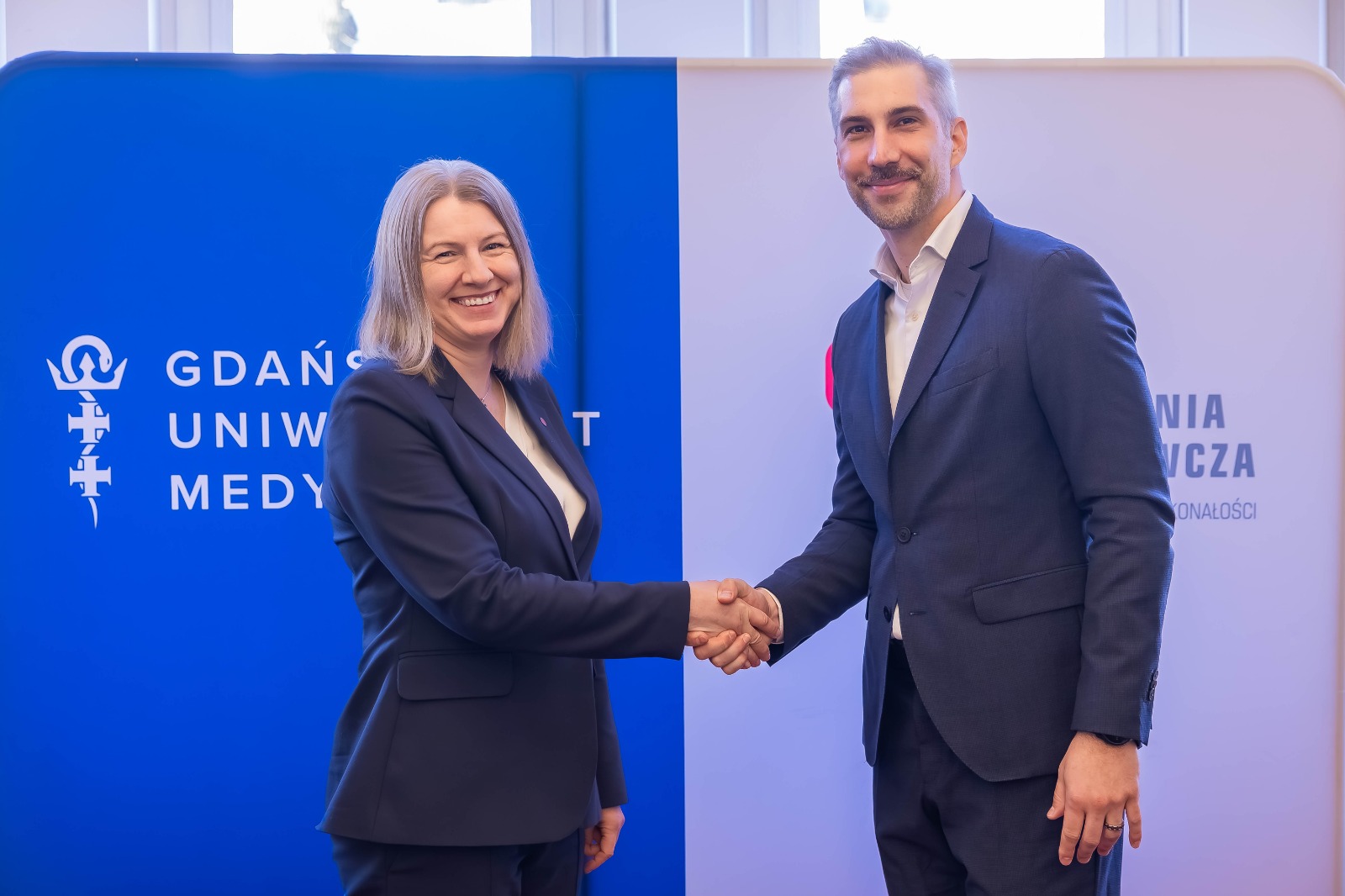
LIFE bioCEEd has announced its entry into the development of a novel therapeutic approach for multiple sclerosis, which has the potential to fundamentally change the current treatment paradigm for this chronic disease. The project originated at the Medical University of Gdańsk in Poland as part of research led by neuroscientist Dr. Rutkowska, whose work has long focused on nerve tissue regeneration and the mechanisms of brain damage in neurological diseases.
Multiple sclerosis is a chronic autoimmune disease in which the immune system attacks the brain and spinal cord. A key consequence is damage to myelin, the protective layer surrounding nerve fibres that ensures the rapid transmission of electrical signals in the nervous system. Damage to this layer leads to a slowing down or cessation of signals, which manifests as a gradual loss of mobility, impaired vision, fatigue, coordination problems and cognitive difficulties. Multiple sclerosis often affects people of working age, significantly reducing their quality of life and placing a burden on both the healthcare and social systems.
Although there have been significant advances in multiple sclerosis research over the past decades, current treatments have key limitations. They can slow the disease by suppressing the immune system, but they are unable to repair the damage the disease has already caused. In practice, this means that treatment can slow the disease down, but it does not restore patients to their original condition. It is precisely this inability to regenerate nerve tissue that is considered the main unresolved problem of current multiple sclerosis therapy.
A unique solution
The new project that LIFE bioCEEd is embarking on takes a completely different strategic approach. The molecule CF₃‑7α,25‑OHC, currently being developed for therapeutic use, is is designed to modulate pathological immune activity while influencing processes associated with myelin repair. – the structure whose damage is the cause of most neurological difficulties in multiple sclerosis patients. This combination of immunomodulatory and regenerative effects in a single preparation is considered a potential breakthrough, as existing treatments have focused either on suppressing the immune system or on neuroprotective effects, not on both simultaneously.
Preclinical results to date suggest that this approach may have real clinical potential. In experimental models, not only was a reduction in CNS inflammation observed, but also changes consistent with myelin-related repair processes”. This suggests that, in the future, this could be a therapy that not only halts disease progression but may have the potential to influence disease progression and functional outcomes.
The role of the research team
The research is led by Dr. Aleksandra Rutkowska, a respected expert in neurobiology and research into demyelinating diseases. She is a researcher and a group leader at the Medical University of Gdańsk . Her scientific career includes work at Trinity College Dublin, where she focused on molecular neurobiology and research into receptors regulating the behaviour of immune cells in the brain. Her contribution to the field of neuroscience has been recognised, among other things, by the prestigious L’Oréal-UNESCO For Women in Science programme. “I was impressed by how effectively LIFE bioCEEd works with complex biological phenomena, makes decisions and drives things forward, whilst genuinely listening to the scientific perspective,” added Aleksandra Rutkowska.
The project builds on research supported by the Polish National Science Centre (NCN), whose funding enabled the development of the underlying scientific concepts and early experimental validation. This support played a key role in advancing the project from fundamental research to its current translational stage.
Transition of the project from basic research to clinical development: LBC
LIFE bioCEEd is joining the project at a stage where there is solid preclinical proof of concept, but the technology is not yet ready for testing in humans. The company is thus taking on a key role in moving the project from the academic environment into the clinical development phase. This involves developing a regulatory strategy, validating manufacturing processes, preparing clinical trial protocols and coordinating the other intermediate steps required for drug registration.
Investments running into millions of euros are structured as a multi-phase project, within which LIFE bioCEEd acts as the lead investor. It coordinates additional capital, establishes strategic partnerships and actively develops the project’s scientific potential for clinical application and the global market.
“This project has the potential to offer a new direction in the treatment of multiple sclerosis towards nerve tissue regeneration, an area where medicine is still reaching its limits. For us, this is precisely the type of initiative that aligns with our strategy: to identify exceptional scientific projects across Europe and actively guide them towards clinical application and global implementation,” explains Stefan Savić, CEO of LIFE bioCEEd.
Global context: multiple sclerosis as a major challenge
Approximately 2.8 million people worldwide currently suffer from multiple sclerosis, with roughly half of them living in Europe, which is one of the regions with the highest prevalence of the disease. Multiple sclerosis represents a significant medical and financial burden; the global market for treatment exceeds tens of billions of euros annually and continues to grow. Nevertheless, there is still no therapy that can reliably restore already damaged nerve tissue, which is precisely why regenerative approaches are one of the most intensively studied areas of contemporary neurology and immunology.
The project supported by LIFE bioCEEd aims to aims to contribute to addressing this challenge. If the potential of the CF₃‑7α,25‑OHC molecule is confirmed in clinical trials, this could represent a major step forward not only in the treatment of MS, but also in the management of other central nervous system disorders in which myelin dysfunction and chronic inflammation play a decisive role.


