

```html
Connecting human, animal and ecosystem health.
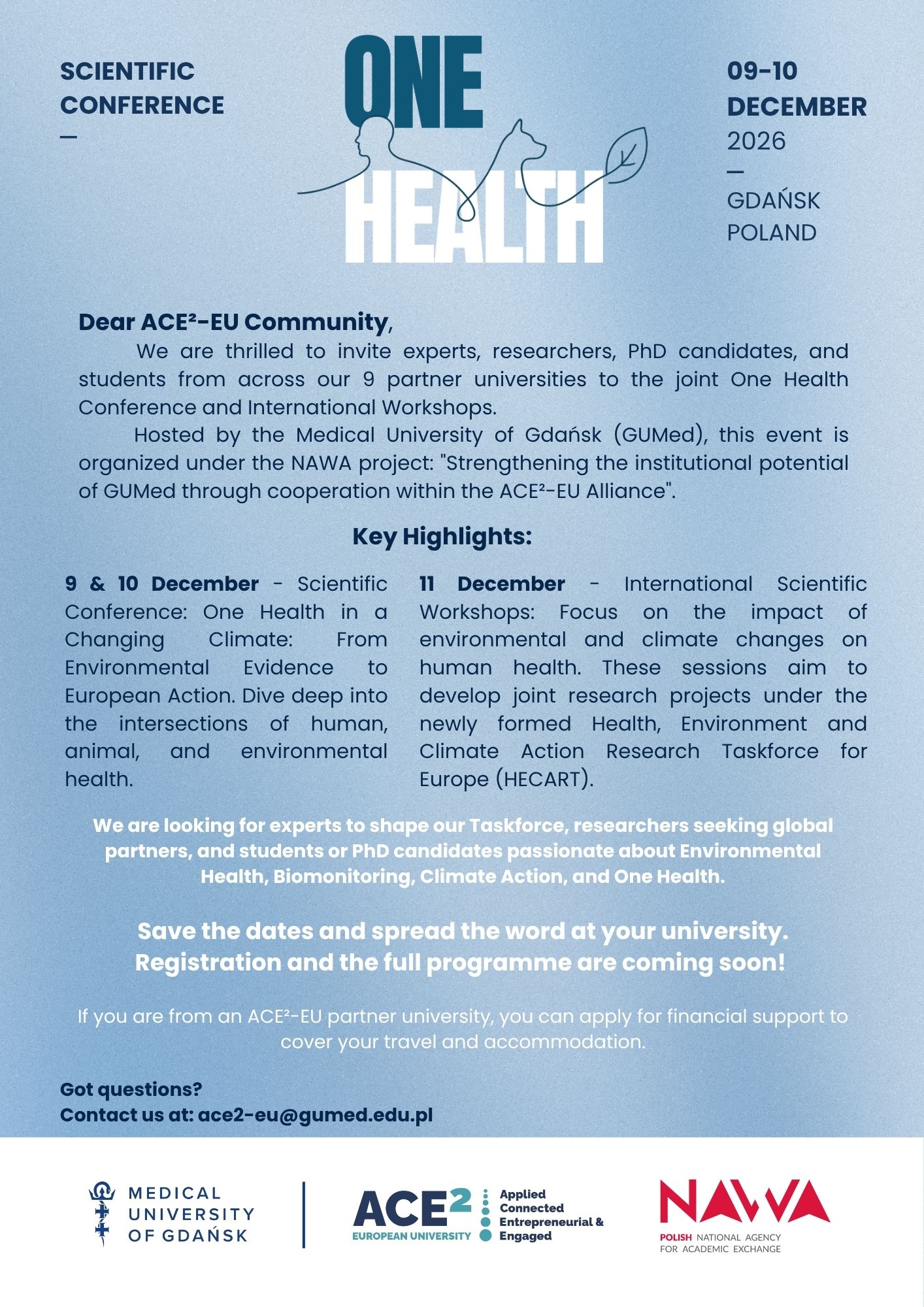
An international event bringing together experts, researchers, academic teachers, early-career scientists, doctoral candidates and students from all ACE²-EU partner universities.
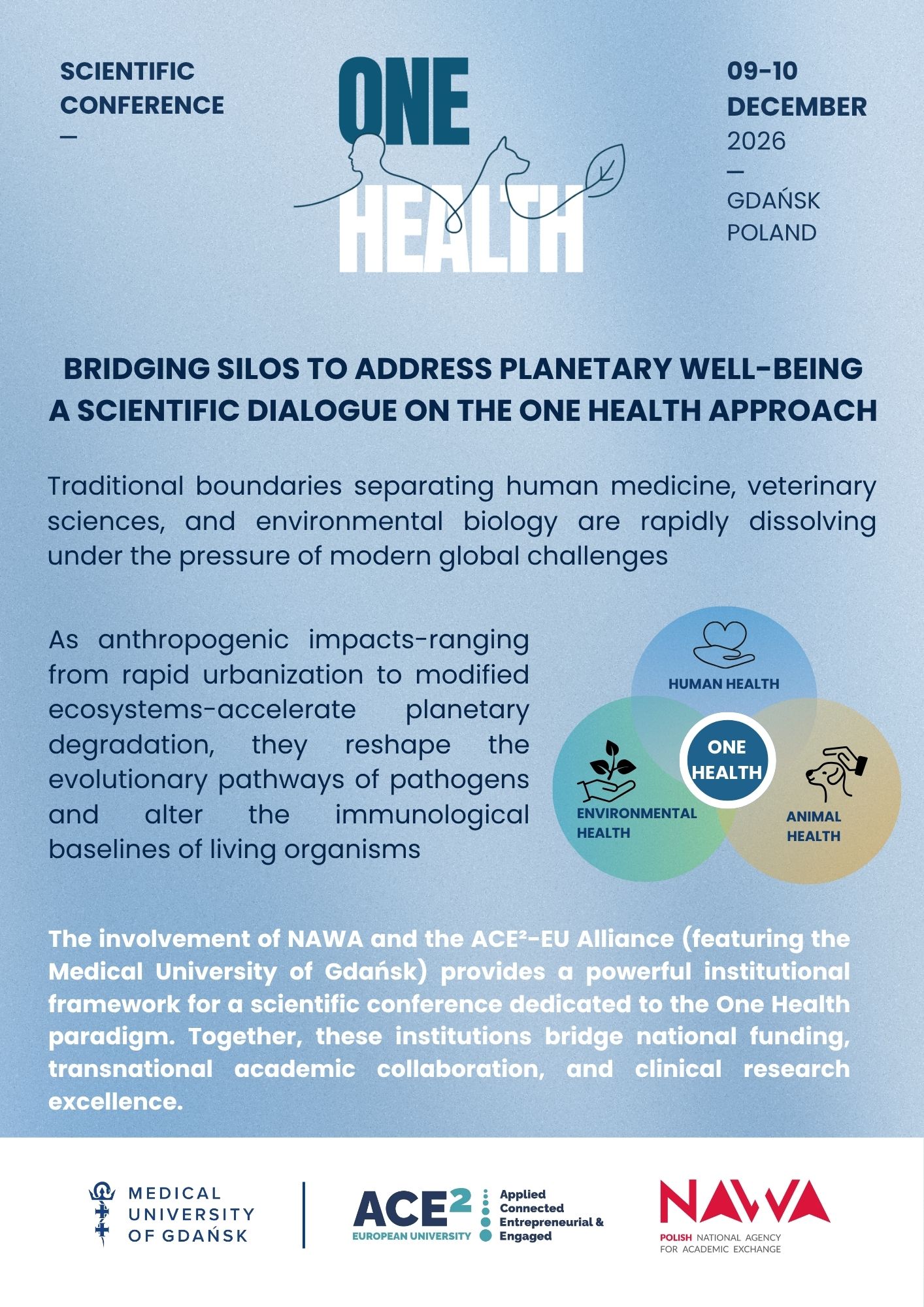
The Medical University of Gdańsk invites the ACE²-EU community to an international scientific conference dedicated to the One Health approach, with a particular focus on environmental determinants of health and the consequences of climate change.
The event will create a space for scientific exchange, interdisciplinary dialogue and the development of new international research collaborations.
Save the dates.
December 2026
Scientific Conference: One Health in a Changing Climate – From Environmental Evidence to European Action.
December 2026
Continuation of the international scientific programme and interdisciplinary exchange.
December 2026
International scientific workshops focused on environmental and climate-related impacts on human health.
One Health beyond disciplinary boundaries.
Health | Environment | Technology | Society
01 Environmental Health, Exposure Assessment and Biomonitoring
Chemical, physical and biological exposures linking environmental quality with human health. Topics include environmental toxicology, the exposome, air quality and indoor environments, water and soil pollution, environmental epidemiology, exposure assessment and human biomonitoring. Contributions may address emerging contaminants, environmental and biological indicators, mixture effects, health-risk assessment and the prevention of environmentally related diseases, including vector-borne diseases.
02 Climate Change, Medicine and Public Health
The health consequences of heat, extreme weather events and changing environmental conditions. Topics include occupational health, vulnerable populations and preventive approaches across different stages of life.
03 Ecosystems, Biodiversity, Agriculture, Food and Animal Health
The interconnections between healthy ecosystems, human and animal health, and safe, sustainable food systems. Topics include biodiversity, environmental microbiology, zoonoses, antimicrobial resistance, animal welfare, sustainable agriculture, food quality and safety, aquatic ecosystems, forestry, land use and ecosystem services.
04 Healthy Cities, Buildings, Infrastructure and Mobility
Engineering and planning solutions that protect health in the face of environmental and climate challenges. Topics include healthy indoor environments, urban overheating, noise and air pollution, blue-green infrastructure, resilient buildings, water infrastructure, landscape planning, transport emissions and active mobility.
05 Clean Energy, Circular Economy and Environmentally Safe Technologies
The environmental and health implications of energy systems, industrial processes, products and resource use. Topics include low-emission technologies, renewable energy, sustainable materials, waste management, wastewater treatment, resource recovery, pollution prevention, life-cycle assessment and chemical safety. Particular attention is given to benefits and trade-offs: low emissions and circularity do not automatically guarantee safety for human health and ecosystems.
06 Digital One Health: Data, Artificial Intelligence and Monitoring
Digital methods connecting environmental, climate, ecosystem and health data. Topics include sensors, remote sensing, geographic information systems, data integration, artificial intelligence, modelling and decision-support tools. Contributions may address early-warning systems, exposure forecasting, digital health, smart infrastructure and the responsible use of technology.
07 Behaviour, Mental Health, Physical Activity and Social Inclusion
Behavioural and social mechanisms linking environmental change with health and well-being. Topics include climate-related psychological distress, risk perception, health literacy, physical activity in natural and urban environments, healthy ageing, social inequalities, participation and the needs of vulnerable groups.
08 Culture, Arts, Humanities and Environmental Health Communication
Cultural and creative perspectives on the relationship between people, nature, health and environmental change. Topics include well-being, heritage and community resilience, health and climate narratives, science communication, and arts-based and creative practice research.
09 Policy, Law, Economics and Governance in One Health
Translating environmental and health evidence into decision-making. Topics include public policy, environmental and health law, health impact assessment, climate adaptation governance, environmental justice, health economics, sustainable business, public administration and organisational change.
From evidence to practical skills.
Students and doctoral candidates will work alongside specialists in laboratory-based environmental measurements and biomonitoring.
Practical workshops
Participants will develop competencies in:
- Environmental measurements and sampling strategies
- Assessment of environmental exposures relevant to human health
- Environmental monitoring and data interpretation
- Biomonitoring approaches and biological indicators
- Linking environmental data with health-oriented research questions
- Interdisciplinary teamwork within the One Health framework
Working alongside specialists, participants will gain practical experience with selected methods used to characterise environmental exposure and its relevance to health.
Building HECART together.
The three-day event is designed to support the establishment of the Health, Environment and Climate Action Research Taskforce for Europe (HECART) — a collaborative platform for joint research projects, publications, grant proposals, training activities and evidence-based action within ACE²-EU and beyond.
Bring your expertise. Find new partners.
Experts & practitioners
Share knowledge and help shape the Health, Environment and Climate Action Research Taskforce for Europe.
Researchers
Meet international partners and explore opportunities for interdisciplinary research and future collaboration.
Students & doctoral candidates
Take part in the scientific programme and develop practical competencies during the workshops.
ACE²-EU partner universities
Participants from ACE²-EU partner universities may apply for financial support for eligible travel and accommodation costs, subject to available project funds and applicable funding rules.
Participants
Participants from ACE²-EU partner universities may apply for financial support to cover eligible travel and accommodation costs, subject to the availability of project funds and the applicable funding rules.
Organizers
Department of
Environmental Toxicology MUG
More information
Location
Medical University of Gdańsk
Gdańsk, Poland

This event is funded by the Polish National Agency for Academic Exchange (NAWA) under the WUE 2025 programme.
```