

The annual celebration of the internationalisation of Polish higher education was held this year at the Jagiellonian University in Kraków. The conference Internationalisation in the face of new challenges was accompanied by a meeting of the Committee for International Cooperation of the Conference of Rectors of Academic Schools in Poland (KRASP), chaired by Prof. Marek Pawełczyk, Rector of the Silesian University of Technology in Gliwice, as well as a workshop featuring Joanna Skupniewska-Morawska, Head of the Division for Visas and the National Dimension of Visa Policy, and Aleksander Dańda, Ph.D. former Consul in Hong Kong and Mumbai. The workshop focused on cooperation with Polish consular missions in countries of strategic interest to Polish universities. The event was organised within the framework of the Study in Poland programme.
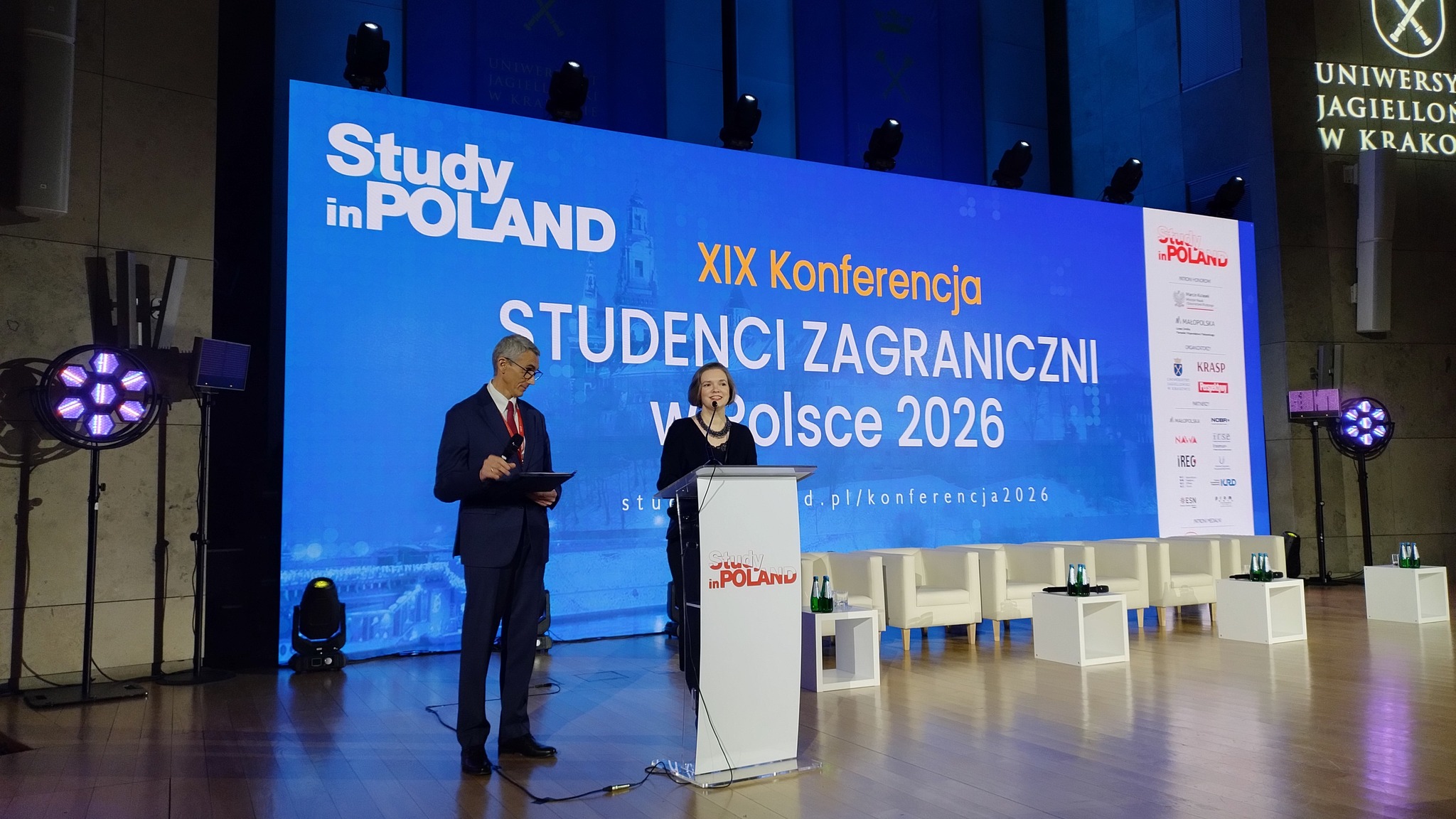
The Medical University of Gdańsk (GUMed) was represented by: Prof. Aleksandra Gaworska-Krzemińska, Vice-Rector for Student Affairs, Sławomir Wójcik, M.D., Ph.D., D.Sc., Head of the Admissions Office, Ewa Kiszka, Head of the Office for Internationalisation and Anna Kiszka, Deputy Head of the Admissions Office.
Sławomir Wójcik, M.D., Ph.D., D.Sc. participated in the Building a Culture of Internationalisation in Polish Universities discussion panel, organised by the conference partner, IROs Forum. Ewa Kiszka was a speaker in the panel organised by the Foundation for the Development of the Education System, moderated by Katarzyna Aleksy, Director of the Office for Higher Education Programmes, entitled Internationalisation Begins with the Student. Thanks to the presence of representatives of the Ministry of Foreign Affairs, delegates from numerous countries, including ambassadors (e.g. Vietnam, Turkey, Uzbekistan), and recruitment agencies, Prof. A. Gaworska-Krzemińska and her team conducted numerous discussions on new student recruitment markets for programmes taught in English.
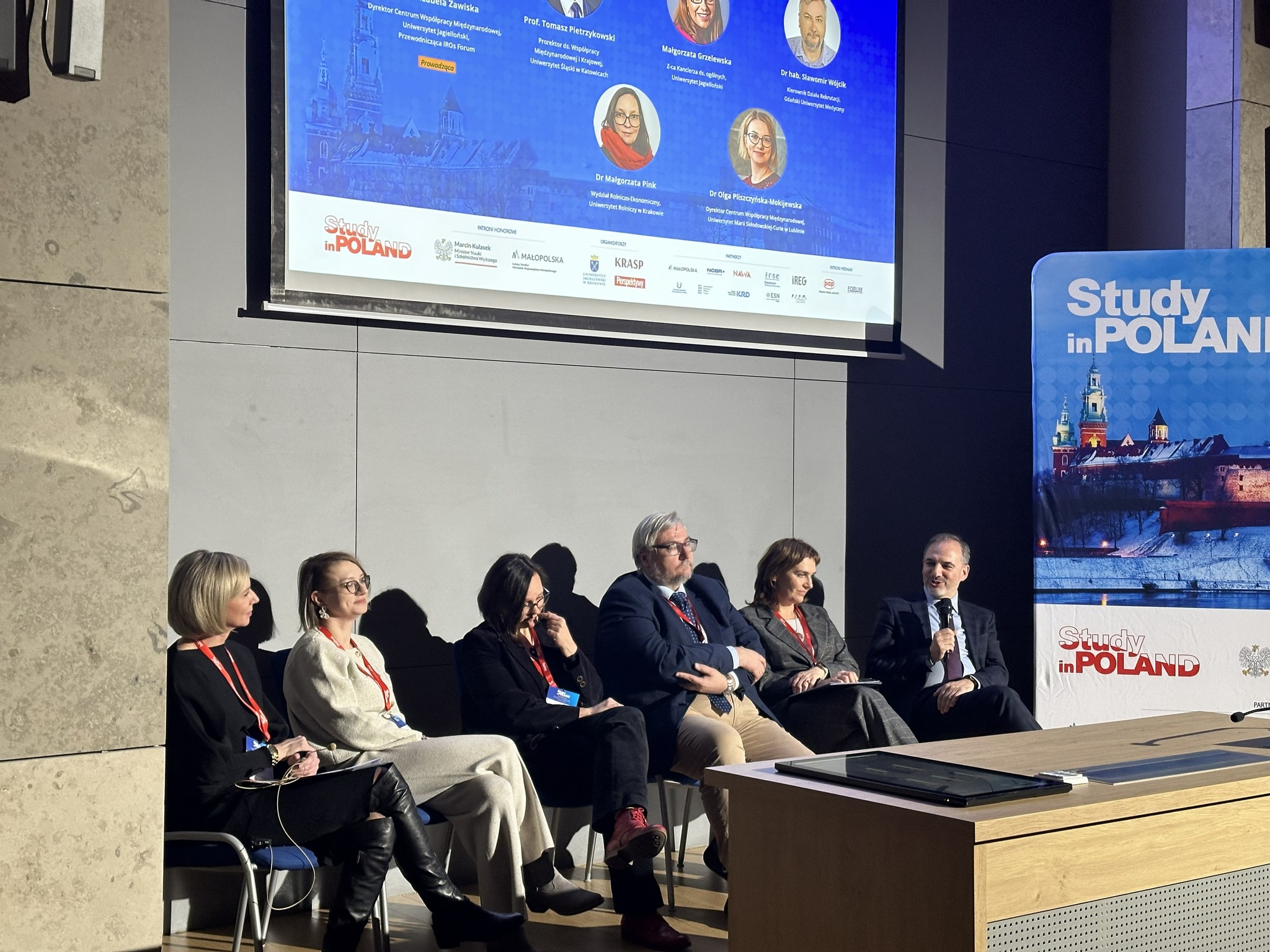
During six plenary sessions, participants discussed the declining number of foreign students admitted to Polish universities, resulting from challenges related to changes in visa requirements, as well as uncertainty in global politics and the economy.
Attention was also devoted to prospective directions and markets of cooperation for Polish universities, Poland as an educational brand, instruments for enhancing the attractiveness of Polish higher education institutions, more effective use of European funds for research and development, and the potential of students of Polish origin living abroad. The results of the report International students in Poland – economic Iimpact, prepared by the University of Economics in Katowice, were also presented.
The first day of the conference concluded with a ceremonial gala at the Wieliczka Salt Mine, during which the Internationalisation Stars 2026 awards were presented, along with prizes for the best international students in Poland in the INTERSTUDENT competition.
According to the report International students in Poland 2025, prepared by the Perspektywy Educational Foundation, the Medical University of Gdańsk ranks:
· 3rd in the Pomeranian Voivodeship in terms of the number of international students,
· 40th in Poland in terms of the number of international students,
· 2nd in Poland in terms of the number of international students in the medical programme,
· 12th in Poland in terms of the number of international students in nursing,
· 4th in terms of the number of students from India,
· 3rd in terms of the number of students from Norway,
· 7th in terms of the number of students from Nigeria, 9th from Italy, and 8th from Lithuania.
– The number of foreign students admitted to Polish universities is decreasing. This is not solely due to new visa requirements, to which universities are gradually adapting. Other challenges in our environment, such as the pandemic or the war, also play a significant role. A positive aspect of visa policy is that it influences the quality of students, although for many of them Poland is only a stage in their career path. Today, the key priority in internationalisation is attracting talent, mastering the art of recruiting candidates for degree programmes and doctoral schools, selecting high-quality applicants and focusing on selected countries and regions. However, we must ensure that our educational offer is attractive and aligned with labour market needs. This is crucial, as we are facing an extremely competitive global market for student recruitment, said Prof. Aleksandra Gaworska-Krzemińska.
– Our challenge is also to enhance the quality of scientific and academic cooperation, the ability to collaborate, build research and development alliances, and assume leadership roles. We lack visibility and regular direct contacts that enable the pooling of resources and expertise. Long-term, proven partnerships are key to achieving objectives, including the acquisition of European funds. Effective partnerships cannot be built at the stage of submitting a grant application; they require the identification of shared interests, not merely formal cooperation. All of this requires an environment which fosters international collaboration at every level of university functioning – namely, a culture of internationalisation, openness to cultural diversity and a global perspective, added Prof. Anna Żaczek, Vice-Rector for Development and Cooperation at the MUG.
The event was organised by the Perspektywy Educational Foundation and the host institution – the Jagiellonian University – within the framework of the Study in Poland programme, jointly implemented by the Conference of Rectors of Academic Schools in Poland and the Perspektywy Educational Foundation. The conference was held under the honorary patronage of Marcin Kulasek, Minister of Science and Higher Education.
Photo: Fundacja Edukacyjna Perspektywy


